
The Course
Hole-by-Hole Descriptions
01 | 02 | 03 | 04 | 05 | 06 | 07 | 08 | 09
10 | 11 | 12 | 13 | 14 | 15 | 16 | 17 | 18

Course Yardages
Course Yardages »

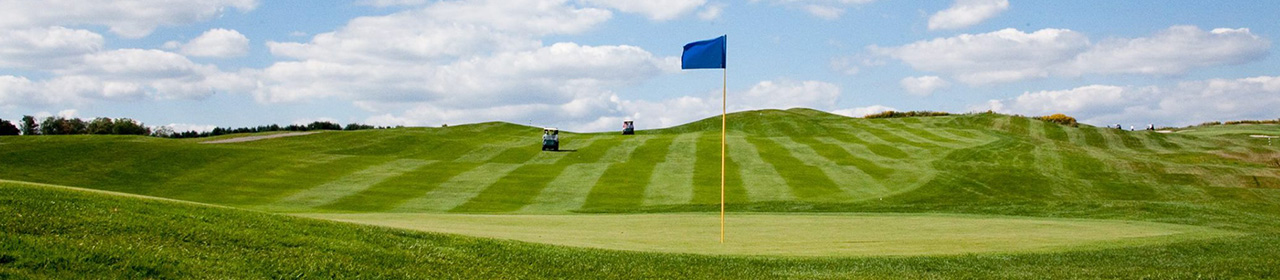
The whimsical name 'Birdsfoot' gives golfers a hint of what they're about to enjoy at this great Freeport course, a Pittsburgh favorite. Where many lesser golf courses pulse with pretense, Birdsfoot's a charming gem that scores with friendly staff and great golf that'll test all skill levels.
The course features 18 distinct holes -- including four of the area's toughest par 3s -- that attract golfers from all over the tri-state area and challenge every club in the bag. Links-style holes on the front nine mingle with parkland beauties played out over rolling hills that are indifferent to bounces good and bad.
No homes mar the scenery, save for the clubhouse, an old family farmhouse, that looks like it was airlifted from the set of
The Waltons.

A local artist has been commissioned to carve beguiling 'Bogeymen' into the gnarled bark of trees that line the cartpath. Grim-faced and unblinking, they're likely to be the only faces that aren't smiling at Birdsfoot."
- Chris Rodell,
Golf Magazine
Hole No. 1
Architect's Description & Strategy

This starting hole has a generous landing area for the opening tee shot. Be sure to challenge the fairway bunker on the left in order to set up a better angle for your approach shot. Just be sure you have enough club in order to reach the multi-tiered uphill green.
Hole No. 2
Architect's Description & Strategy

This demanding Par 5 hole offers a fair opportunity to grip it and rip it off the tee. The tricky part comes with the 2nd shot, where you must determine the best place to lay up. Let the cross bunker on the right be your guide. You must commit to flying over it for a chance to hit the green in two or lay up short of it in order to set up the best angle to the pin.
Hole No. 3
Architect's Description & Strategy

As this is one of the longest Par 4s on the course, the safest way to play this bunkerless hole is down the right side because everything falls from right to left. The green is both large and subtle realizing that most approach shots will be hit with fairway woods and long irons.
Hole No. 4
Architect's Description & Strategy

This is target golf at its best. Being the shortest Par 3 out of four, this beautiful little hole is guarded by a pond on the left with two bunkers at the back of the green. You must hit an accurate tee shot to get close to the pin; or you can bail-out short right and be faced with a difficult up and down to the small green which is separated into three distinct pinable areas.
Hole No. 5
Architect's Description & Strategy

With no shortcuts, this Par 5 plays uphill all the way! Hit your tee shot to the deck in the 1st landing area and determine how far to lay up for your approach shot into the green. Take special notice of where the pin is located, as this elevated green has a low, medium, and high level which could mean the difference between a wedge or 8-iron.
Hole No. 6
Architect's Description & Strategy

This short dogleg right is peppered with bunkers on both sides of the fairway and is surrounded by natural grasses. You can play this hole conservatively for a good chance to make birdie; or, if you can successfully muster up a power fade, it may be worth the risk to take a shot at driving the green. But, if you’re off the mark, you will be lucky to make bogey instead of having a shot at an eagle.
Hole No. 7
Architect's Description & Strategy

Fit your tee shot somewhere down the right side of the fairway, but beware of the pond guarding the outside of the dogleg. The green is a wide target with good depth. However, don’t be fooled by the front left bunker that is deceptively short of the putting surface.
Hole No. 8
Architect's Description & Strategy

A very dramatic and straightforward Par 4 with the fairway divided by a terrace that runs down the middle of the hole creating a high side on the right and low side on the left. All the trouble is on the left side. Therefore, if you play along the high side of the hole you’ll be afforded the best view and the best angle in order to attack the green. There is a safe area just short right of the green to bailout to.
Hole No. 9
Architect's Description & Strategy

Lace up your spikes and pick the right club. This spectacular finishing hole on the front nine has a fair amount of room to the right and left as long as you can carry the ravine. The green is among the largest on the course with a subtle amount of undulation, so if you make it to the putting surface, you’ll have a good chance at birdie.
Hole No. 10
Architect's Description & Strategy

A blended sea of native grasses is the obstacle off the tee. Challenge the left side of the hole on your tee shot and pick the correct angle to the pin because distance is a factor as the green sits in the slope on an angle from left to right. The bunker on the right will gobble up any shot short of the putting surface.
Hole No. 11
Architect's Description & Strategy

A bunker surrounds the green on this slightly uphill Par 3. There is a narrow opening in the front allowing shots to run onto the putting surface. But, if you miss the green long or to either side, you’ll need to make a sandy for par.
Hole No. 12
Architect's Description & Strategy

With the most elevation change from tee to green on the course, this strong Par 4 demands a good tee shot up the left side toward the two target bunkers; or you’ll be scrambling to make a 4 from the get go. A double approach to the green opens up two different avenues around a small pot bunker in the front, and a terrace running laterally through the center of the green will help feed the ball to a back right pin.
Hole No. 13
Architect's Description & Strategy

The first of the tree lined holes on Birdsfoot Golf Club, this Par 5 requires accuracy from tee to green. If your in a position to take a crack at the green in two, it’s better to miss it long because of the expanded collar that extends from the left side to the very back of the green offering various options to get up and down for a birdie.
Hole No. 14
Architect's Description & Strategy

This picturesque dogleg right has bunkers framing the landing area with grassy hollows all the way up the left side. The green is bunkered much the same as the landing area, but be aware of a bowl in the middle right of the putting surface. It will collect any approach shot that is not hit on target, or the correct distance.
Hole No. 15
Architect's Description & Strategy

With trees on both sides of the landing area and through to the green, this medium length Par 4 demands accuracy starting with the first shot. You don’t need to overpower this hole; all you need is a safe tee shot that finds the short grass, then concentrate on your approach shot into this small and shallow green.
Hole No. 16
Architect's Description & Strategy

Considering all the Par 5’s on the course, this one offers the best chance for an eagle if you negotiate the two cross bunkers short left of the green. Playing to the right of the lone Oak tree in the center of the fairway will give you the shortest distance to the green in two, but the hillside along the right hides it from view. If you have the length to get it there, take dead aim at the green and trust your line, you may end up putting for a three.
Hole No. 17
Architect's Description & Strategy

One of only two bunkerless holes on the course, this long and slightly downhill Par 3 is one of the most eye appealing holes at Birdsfoot Golf Club. With a number of striking grass depressions surrounding the green complex, you must be on target and you must pick the right stick. Know your distance because this green is large enough to make you choose between three different clubs depending on where the pin is cut.
Hole No. 18
Architect's Description & Strategy

A good length finishing hole, the 18th offers a couple of options on how to end your round on a high note. There are two fairways separated by a long spine down the middle of the hole. Commit to your decision on the tee and determine whether you’re better off accepting more of a challenge on the 1st shot or the 2nd shot into the green.
The fairway on the right may appear a bit more inviting, but it runs out about 265 yds. from the back tee with a bunker cutting directly across the flight-line that restricts the length of tee shots. Also, from that angle in, there is a large imposing bunker guarding the entire front right side of the green on your approach. The more obscure fairway on the left allows you to hit it as far as you can if you find the slot. The 2nd shot from this fairway opens up to a double approach on either side of a small pot bunker located at the front left of the green.